
SkyMirr’sSky5G CPE platform was developed with a simple engineering premise: in real-world wireless deployments, performance is often limited not by the modem or software stack, but by the antenna subsystem.
Sky5G is a marquee example of what becomes possible when broadband hardware is designed from the RF layer up—prioritizing radiation efficiency, coupling control, and MIMO integrity as primary performance drivers.
This antenna-first philosophy reflects a broader truth in modern connectivity:
Wireless performance starts at the antenna.
For engineers working with 4G/5G Sub-6 systems, fixed wireless access (FWA), or high-density edge deployments, the RF front end—not the chipset—is frequently the dominant factor in achievable throughput, coverage consistency, and link stability.
The Antenna Is Not a Commodity Component
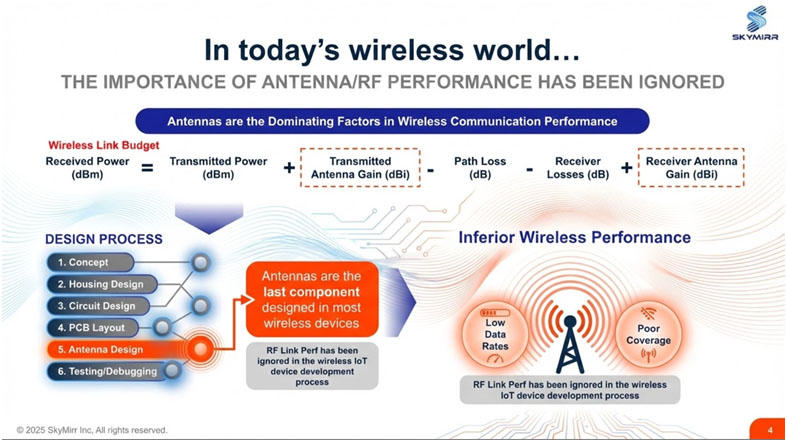
In many wireless devices, antennas are still treated as packaging constraints rather than performance-defining subsystems. As form factors shrink and frequency coverage expands, this approach introduces predictable challenges:
- Reduced radiation efficiency due to enclosure effects
- Pattern distortion caused by mounting surfaces or nearby metal
- Detuning across wide operating bands
- Increased mutual coupling between closely spaced radiators
- Higher correlation, limiting effective MIMO gains
Even when a modem supports advanced features like carrier aggregation or high-order modulation, the system cannot realize those benefits if antenna efficiency and isolation are compromised upstream.
In practice, many “network problems” are actually RF problems.
Why Coupling and Correlation Matter for MIMO
Modern broadband CPE platforms depend heavily on multi-element antenna architectures. However, as radiators are placed closer together, mutual coupling increases and isolation decreases. This can degrade key parameters such as:
- Envelope Correlation Coefficient (ECC)
- Diversity gain
- Signal-to-interference-plus-noise ratio (SINR)
- Realizable spatial multiplexing performance
The result is often unstable throughput, reduced spectral efficiency, and weaker performance at the cell edge—particularly in high-multipath or interference-heavy environments.
Antenna-first engineering addresses these physical-layer constraints early in the design process rather than attempting to compensate later through software.
Antenna-First Design as a System-Level Strategy
An antenna-first approach prioritizes RF performance as the foundation of the connectivity stack. This typically includes:
- Improving total radiation efficiency to strengthen link margin
- Increasing inter-element isolation to preserve MIMO behavior
- Maintaining consistent radiation patterns to reduce dead zones
- Optimizing impedance matching across wide frequency ranges
- Minimizing coupling effects that reduce diversity performance
These factors directly influence the metrics that matter in deployment: fewer retransmissions, higher usable throughput, and more consistent connectivity under load.
MuLCAT® and Coupling-Controlled Architectures
One emerging design approach involves actively managing energy interaction between radiators rather than treating coupling as unavoidable.
SkyMirr’sMuLCAT® (Multi-Layer Coupling Controlled Antenna Technology), implemented in platforms such as Sky5G, is designed to improve isolation and efficiency in compact multi-element broadband systems by controlling how energy flows across antenna layers and elements.
The goal is to preserve real-world MIMO performance in constrained form factors—where traditional approaches often struggle.
Sky5G as an Antenna-First CPE Example
Sky5G was engineered with RF performance as a primary design driver, supporting:
- Multi-band 4G LTE and 5G Sub-6 operation
- Efficient omni-directional behavior in real installations
- Reduced coupling to protect MIMO integrity
- More stable throughput in weak-signal or high-density environments
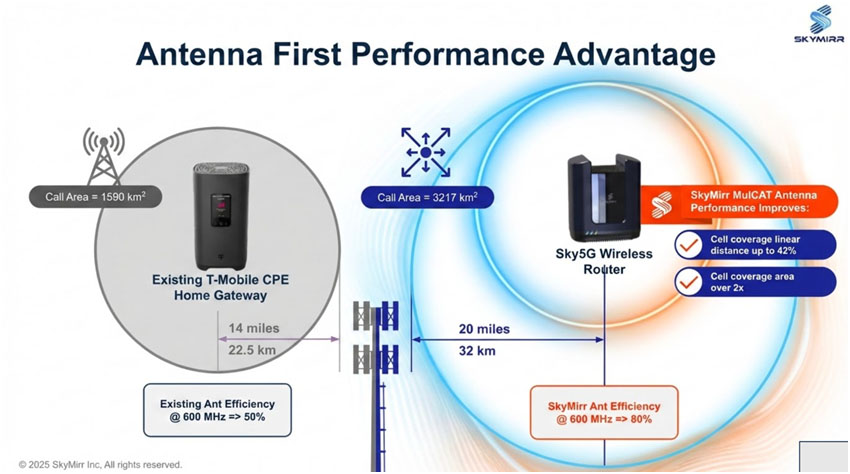
In testing, Sky5G has demonstrated broadband reach up to 42% farther from cell towers (carrier and conditions dependent), illustrating the impact of improved link margin at the antenna layer.
This design focus becomes especially relevant in rural deployments, dense urban networks, temporary sites, and fixed wireless environments where wired broadband is delayed or impractical.
Key Takeaway for Designers
As wireless connectivity expands into more demanding use cases—edge computing, industrial IoT, multi-site enterprise networks, and broadband replacement—the antenna subsystem is increasingly the performance bottleneck.
Antenna-first design is not simply an optimization. For many modern 5G systems, it is becoming a requirement to achieve consistent real-world throughput, coverage, and reliability.
For engineers evaluating broadband hardware, the question is no longer just what modem is inside—but how effectively the RF layer is engineered to deliver performance where it counts.